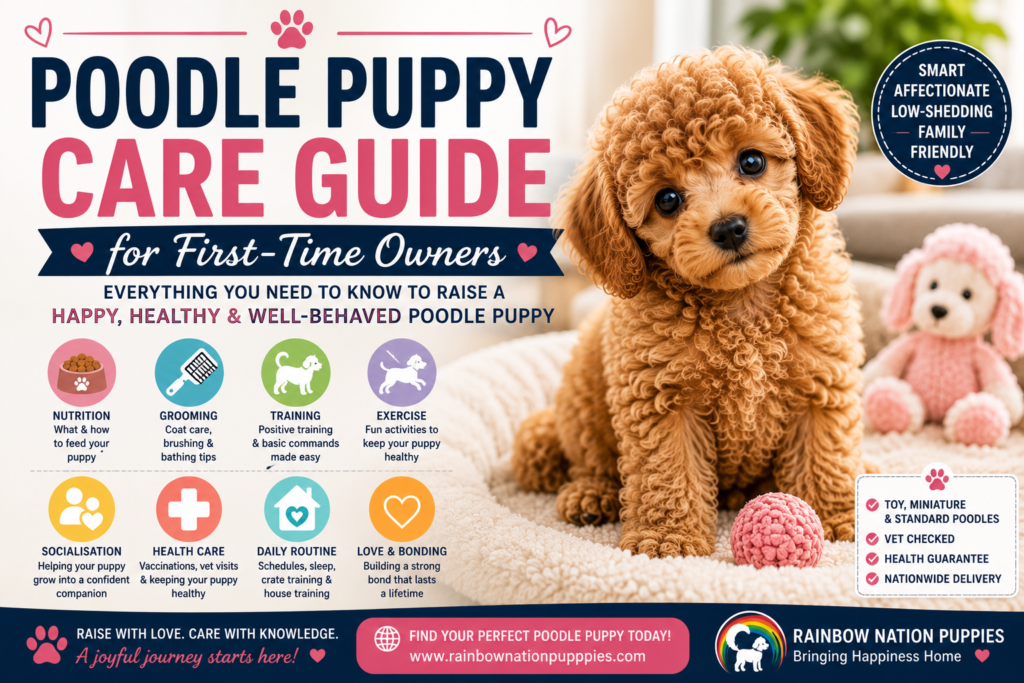
Bringing home a Poodle puppy is an exciting experience, especially for a first-time dog owner. Poodles are intelligent, affectionate and highly trainable dogs, but they also have specific grooming, exercise, training and healthcare needs that new owners should understand.
Whether you are bringing home a Toy Poodle, Miniature Poodle or Standard Poodle, good care starts from the first day. Establishing a consistent routine, feeding an appropriate puppy diet, arranging veterinary care, beginning gentle training and introducing grooming early can help your puppy grow into a confident and well-mannered companion.
For South African families looking for a Poodle puppy, Rainbow Nation Puppies’ Poodle puppy page currently features Toy, Miniature and Standard Poodle listings. The page also identifies individual puppies as vet checked and provides information about the available puppies.
This Poodle puppy care guide for first-time owners explains everything you need to know about feeding, grooming, exercise, training, socialisation, health and creating the right home environment.
Table of Contents
- Understanding Your Poodle Puppy
- Preparing Your Home
- Feeding Your Poodle Puppy
- Creating a Daily Routine
- House Training
- Poodle Puppy Grooming
- Exercise and Play
- Training Your Poodle Puppy
- Socialisation
- Veterinary Care and Vaccinations
- Dental Care
- Toy, Miniature and Standard Poodle Differences
- Common Mistakes First-Time Owners Make
- Poodle Puppy Care in South Africa
- Frequently Asked Questions
- Conclusion
Understanding Your Poodle Puppy
Poodles are recognised in three size varieties: Toy, Miniature and Standard. Their care needs overlap, but size can influence exercise requirements, feeding quantities, growth rate and handling.
The American Kennel Club notes that Poodle puppies develop at different rates depending on their variety, with Toy and Miniature Poodles generally reaching maturity earlier than Standard Poodles.
Poodles are known for being:
- Intelligent
- Active
- Affectionate
- Alert
- Eager to learn
- People-oriented
- Highly trainable
Their intelligence is one of their greatest strengths, but it also means they need mental stimulation. Simply leaving a Poodle puppy alone for long periods without interaction can result in boredom and unwanted behaviours.
A successful first-time owner should think of puppy care as a combination of health, nutrition, grooming, training, exercise and companionship.
Preparing Your Home for a Poodle Puppy
Before your puppy arrives, prepare a safe area where it can sleep, eat and play.
Essential Puppy Supplies
Consider preparing:
- Puppy food
- Food and water bowls
- Comfortable puppy bed
- Puppy-safe toys
- Collar or harness
- Lead
- Identification tag
- Grooming brush
- Puppy shampoo
- Puppy-safe cleaning products
- Crate or secure sleeping area
- Training treats
Puppy-Proof Your Home
Puppies are naturally curious and investigate their surroundings with their mouths.
Keep the following safely out of reach:
- Electrical cables
- Cleaning chemicals
- Medicines
- Small objects
- Toxic plants
- Human foods that are dangerous to dogs
- Open rubbish bins
Create clear boundaries from the first day. Decide where your puppy will sleep, where it will eat and where it should go to the toilet.
A consistent environment makes it easier for a puppy to understand what is expected.
Feeding Your Poodle Puppy
Nutrition is one of the most important parts of Poodle puppy care.
Choose a complete and balanced puppy food appropriate for your puppy’s size and stage of development. Your veterinarian can help you select a suitable diet.
When your puppy arrives, ask the seller what food it has been eating. Maintaining the same food initially can make the transition to your home easier.
If you decide to change food, introduce the new food gradually rather than changing the diet suddenly.
How Often Should a Poodle Puppy Eat?
Young puppies generally need several meals throughout the day rather than being fed like adult dogs.
The appropriate feeding schedule depends on:
- Age
- Size
- Weight
- Food type
- Activity
- Veterinary advice
Toy Poodle puppies are particularly small and should be monitored carefully to ensure they are eating appropriately. The AKC notes that Toy puppies can be susceptible to low blood sugar if they do not consume enough calories.
Always provide access to clean, fresh drinking water.
Avoid Dangerous Foods
Do not intentionally feed your puppy foods such as:
- Chocolate
- Grapes
- Raisins
- Onions
- Garlic
- Xylitol-containing products
- Alcohol
- Cooked bones
If your puppy accidentally eats something potentially toxic, contact a veterinarian immediately.
Creating a Daily Routine
A consistent routine is extremely helpful for first-time puppy owners.
Your daily schedule can include:
Morning: Toilet break, breakfast, gentle play and training.
Midday: Toilet break, meal if appropriate, play and rest.
Afternoon: Short training session, play and another toilet break.
Evening: Dinner, family interaction, calm play and toilet break.
Night: Quiet sleeping area and scheduled toilet breaks as needed.
Puppies need plenty of sleep. Do not assume that a puppy being energetic means it needs constant activity.
The AKC recommends establishing a predictable routine around feeding, toilet breaks, play and rest.
Several short play and training sessions are generally more appropriate for a young puppy than one long, exhausting session.
House Training Your Poodle Puppy
House training requires patience and consistency.
Take your puppy to its designated toilet area:
- After waking
- After eating
- After drinking
- After playing
- Before bedtime
- At regular intervals throughout the day
When your puppy toilets in the correct place, immediately reward the behaviour with praise and an appropriate treat.
Accidents Are Normal
First-time owners sometimes become frustrated when a puppy has an accident indoors.
Remember that young puppies are still developing bladder control.
Do not punish your puppy after an accident. Instead:
- Clean the area thoroughly.
- Use a consistent toilet schedule.
- Take the puppy out more frequently.
- Reward successful toilet trips.
Consistency is more effective than punishment.
Poodle Puppy Grooming
Grooming is one of the most important responsibilities of Poodle ownership.
Poodles have continuously growing, curly hair that can become tangled or matted without regular maintenance. The AKC specifically recommends establishing grooming habits early because puppies need to become comfortable with brushing, handling and grooming procedures.
Start Grooming Early
Introduce your puppy gradually to:
- Brushing
- Paw handling
- Ear handling
- Nail trimming
- Tooth brushing
- Bathing
- Clippers and grooming sounds
Keep early sessions short and positive.
Give praise and small rewards so your puppy learns that grooming is a normal and positive experience.
Brushing
Regular brushing helps prevent mats.
Make sure the brush reaches through the coat rather than simply brushing the surface.
If you encounter severe mats, do not attempt to cut them out with household scissors. Professional grooming may be safer.
Professional Grooming
Poodles typically require regular professional grooming.
The exact schedule depends on:
- Coat length
- Hairstyle
- Coat condition
- Individual growth rate
- How frequently you brush at home
Starting grooming experiences early can make future professional appointments much easier.
Exercise and Play
Poodles are active and intelligent dogs.
However, puppies should not be treated like adult dogs when it comes to exercise.
Avoid excessive forced exercise, especially while your puppy is still growing.
Instead, provide:
- Short walks when appropriately vaccinated
- Gentle play
- Supervised exploration
- Interactive toys
- Short training sessions
- Puzzle activities
KUSA guidance notes that exercise requirements vary according to age, breed and health, and that young dogs may need exercise restricted during rapid growth.
Mental Exercise Matters Too
Poodles are highly intelligent, so mental stimulation is important.
Try:
- Teaching simple tricks
- Food puzzles
- Hide-and-seek games
- Name-recognition games
- Basic obedience
- Finding hidden toys
A five-minute training session can provide valuable mental stimulation.
Training Your Poodle Puppy
Training should begin as soon as your puppy arrives home.
Start with simple skills.
Teach Your Puppy Its Name
Say your puppy’s name and reward it when it looks toward you.
Repeat this frequently in a positive environment.
Teach Basic Commands
Begin with:
- Sit
- Come
- Stay
- Down
- Leave it
Keep sessions short and enjoyable.
Use Positive Reinforcement
Reward behaviours you want to see repeated.
Rewards can include:
- Praise
- Treats
- Toys
- Play
- Affection
Avoid harsh punishment.
Poodles are intelligent dogs and can learn quickly, but consistency from the owner is essential.
The AKC recommends beginning training and building good behaviour during the puppy’s early developmental period.
Socialisation Is Essential
Socialisation helps your puppy become comfortable with different people, environments and experiences.
Introduce your puppy gradually to:
- Different people
- Household noises
- Car rides
- Grooming
- Different surfaces
- Appropriate vaccinated dogs
- New environments
Socialisation should be positive rather than overwhelming.
Reward calm behaviour.
Puppy Socialisation and Vaccinations
Your veterinarian can advise when it is safe to visit public areas, puppy classes and interact with other dogs based on your puppy’s vaccination status and local disease risks.
Do not expose an incompletely vaccinated puppy unnecessarily to areas where unknown dogs may have been.
Vaccination schedules should always be determined with your veterinarian. Current veterinary guidance emphasises that puppies need a planned first-year vaccination programme and appropriate follow-up care.
Veterinary Care and Vaccinations
One of the first things you should do after bringing your Poodle puppy home is arrange a veterinary appointment.
Your veterinarian can assess:
- General health
- Weight
- Growth
- Teeth
- Ears
- Eyes
- Heart
- Parasites
- Vaccination status
- Deworming needs
The first veterinary visit is also an opportunity to discuss nutrition, parasite prevention, microchipping and sterilisation.
The AKC recommends arranging a puppy’s first veterinary visit soon after coming home.
Keep Veterinary Records
Keep all vaccination and treatment records safely.
You should know:
- Which vaccines were given
- When the next vaccination is due
- When deworming was performed
- What parasite prevention is being used
- Your veterinarian’s contact details
When buying a Poodle puppy, ask the seller for all available veterinary documentation.
Rainbow Nation Puppies currently lists several Poodle puppies as vet checked, including Toy, Miniature and Standard Poodles. Prospective owners should confirm the latest health and veterinary details for an individual puppy before purchase.
Dental Care for Poodle Puppies
Dental care should begin while your puppy is young.
Introduce tooth brushing gradually.
Start by allowing your puppy to become comfortable with having its mouth and gums touched.
Then gradually introduce a dog-specific toothbrush and toothpaste recommended for dogs.
Never use human toothpaste unless your veterinarian specifically advises it.
Regular dental care can help reduce plaque buildup and support better oral health.
Ear Care
Poodles can require regular attention to their ears.
Check your puppy’s ears regularly for:
- Redness
- Unusual smell
- Discharge
- Excessive scratching
- Sensitivity
Do not insert objects deeply into the ear canal.
If you notice an unusual change, ask your veterinarian to examine the ears and recommend appropriate cleaning.
Nail Care
Long nails can affect comfort and movement.
Start getting your puppy used to having its paws handled from an early age.
Touch each paw gently and reward calm behaviour.
If you are uncomfortable trimming nails yourself, have a professional groomer or veterinary professional do it.
Early handling and grooming practice can make future nail trims much easier.
Toy, Miniature and Standard Poodle Care
The three Poodle varieties share many characteristics, but their size affects certain aspects of care.
Toy Poodle
Toy Poodles are extremely small.
Owners should pay particular attention to:
- Safe handling
- Regular feeding
- Avoiding accidental injury
- Dental care
- Appropriate exercise
Miniature Poodle
Miniature Poodles are larger and often well suited to active families.
They still require:
- Regular grooming
- Training
- Exercise
- Socialisation
- Veterinary care
Standard Poodle
Standard Poodles are significantly larger and can have greater exercise, food and equipment requirements.
They may need:
- Larger beds
- Larger crates
- More food
- More physical activity
- More space for comfortable movement
Regardless of variety, the basic principles of responsible Poodle puppy care remain the same.
How to Care for a Poodle Puppy in South Africa
South African owners should consider the local climate and lifestyle when caring for a Poodle.
During hot weather:
- Provide plenty of fresh water.
- Ensure your puppy has access to shade.
- Avoid strenuous exercise during the hottest part of the day.
- Never leave a puppy in a parked vehicle.
- Provide a cool, comfortable indoor environment.
During walks, remember that pavement can become extremely hot in summer.
Test the surface before allowing your puppy to walk on it.
Flea and Tick Prevention
South Africa has areas where fleas and ticks can be a significant concern.
Ask your veterinarian about an appropriate parasite-prevention programme for your puppy.
Do not use a flea or tick product simply because it is marketed for dogs. Products must be appropriate for the puppy’s age, weight and species.
Poodle Puppy Care: The First 30 Days
The first month at home is an important adjustment period.
Week One
Focus on:
- Rest
- Routine
- Veterinary appointment
- Toilet training
- Gentle bonding
- Introducing the puppy to its new environment
Do not overwhelm the puppy with too many visitors.
Week Two
Begin increasing:
- Short training sessions
- Grooming practice
- Safe socialisation
- Interactive play
Week Three
Continue reinforcing:
- Toilet habits
- Name recognition
- Basic commands
- Calm behaviour
- Grooming routines
Week Four
Your puppy should be developing greater confidence and becoming familiar with your household routine.
Continue building good habits rather than assuming training is complete.
Common Mistakes First-Time Poodle Owners Make
1. Underestimating Grooming
Poodles require regular coat maintenance.
2. Too Much Exercise
Young puppies need age-appropriate activity and plenty of rest.
3. Inconsistent Rules
If your puppy is not allowed on the sofa, everyone in the household should follow that rule.
4. Starting Training Too Late
Begin basic training from the beginning.
5. Ignoring Dental Care
Introduce dental hygiene while your puppy is young.
6. Poor Socialisation
A puppy should gradually experience different people, sounds and environments in positive ways.
7. Feeding Too Many Treats
Treats should be appropriate and accounted for within your puppy’s overall diet.
8. Skipping Veterinary Visits
Preventive veterinary care is essential.
Where to Find Poodle Puppies in South Africa
If you are still searching for your first Poodle puppy, take time to research the seller and ask questions before making a commitment.
Rainbow Nation Puppies currently has a dedicated Poodle category with Toy, Miniature and Standard Poodle puppies, and the current page lists individual puppies with prices and vet-check descriptions.
You can view the current listings here:
Rainbow Nation Puppies – Poodle Puppies
Before purchasing, ask about:
- Puppy age
- Veterinary examination
- Vaccinations
- Deworming
- Parent information
- Expected adult size
- Food currently being fed
- Socialisation
- Documentation
- Collection
- Delivery options
- Health guarantee
The Rainbow Nation Puppies website also provides links to its puppy adoption process, shipping and delivery information and health guarantee.
Poodle Puppy Care Checklist
Use this checklist when preparing for your new puppy:
Before Your Puppy Arrives
☐ Choose a veterinarian
☐ Purchase puppy food
☐ Prepare food and water bowls
☐ Set up a sleeping area
☐ Puppy-proof your home
☐ Purchase safe toys
☐ Buy grooming equipment
☐ Prepare a collar or harness
☐ Prepare a lead
☐ Plan a toilet-training routine
Every Day
☐ Provide fresh water
☐ Feed an appropriate puppy diet
☐ Provide toilet breaks
☐ Provide appropriate play
☐ Practise short training sessions
☐ Give plenty of rest
☐ Provide affection and interaction
☐ Check general wellbeing
Every Week
☐ Brush the coat regularly
☐ Check ears
☐ Check teeth
☐ Check nails
☐ Monitor weight and appetite
☐ Review training progress
Frequently Asked Questions
How often should I feed my Poodle puppy?
The appropriate number of meals depends on the puppy’s age, size, diet and individual needs. Young puppies generally need multiple meals throughout the day. Ask your veterinarian for a feeding schedule appropriate for your puppy.
How often should a Poodle puppy be groomed?
Poodles require regular coat maintenance. Brush your puppy regularly and introduce professional grooming gradually. The exact schedule depends on coat length and condition.
When should I start training my Poodle puppy?
Training can begin as soon as your puppy comes home. Start with simple skills such as responding to its name, toilet training and basic commands.
Are Poodles difficult to care for?
Poodles are intelligent and trainable, but their grooming requirements mean they are not completely low-maintenance dogs. With a consistent routine, they can be excellent companions.
How much exercise does a Poodle puppy need?
Exercise should be appropriate for the puppy’s age, size and development. Several short periods of play and activity are generally preferable to excessive forced exercise.
When should my Poodle puppy see a veterinarian?
Arrange a veterinary appointment soon after your puppy arrives home. Your veterinarian can review its health, vaccination status, parasite prevention, nutrition and development.
Are Poodles good for first-time dog owners?
Yes. Their intelligence and trainability can make them rewarding for first-time owners, provided the owner is prepared for regular grooming, training, exercise and veterinary care.
Where can I find Poodle puppies in South Africa?
Rainbow Nation Puppies has a dedicated Poodle puppy category featuring Toy, Miniature and Standard Poodles. You can check current listings at:
Rainbow Nation Puppies Poodle Puppies
Always confirm current availability, price and health information directly before purchasing.
Conclusion
Learning how to care for a Poodle puppy is one of the most important responsibilities of becoming a first-time dog owner. From nutrition and grooming to training, socialisation and veterinary care, the habits you establish during puppyhood can influence your dog’s health and behaviour for years to come.
Poodles are intelligent, affectionate and highly trainable companions, but they need consistent care and attention. Start with a predictable daily routine, introduce grooming early, use positive training methods, provide appropriate exercise and maintain regular veterinary care.
If you are looking for a Poodle puppy in South Africa, Rainbow Nation Puppies currently offers Toy, Miniature and Standard Poodle puppies through its dedicated Poodle category.
View Poodle Puppies at Rainbow Nation Puppies
Choosing the right puppy is only the beginning. With patience, consistency and plenty of love, your Poodle can become a happy, well-adjusted member of your family.